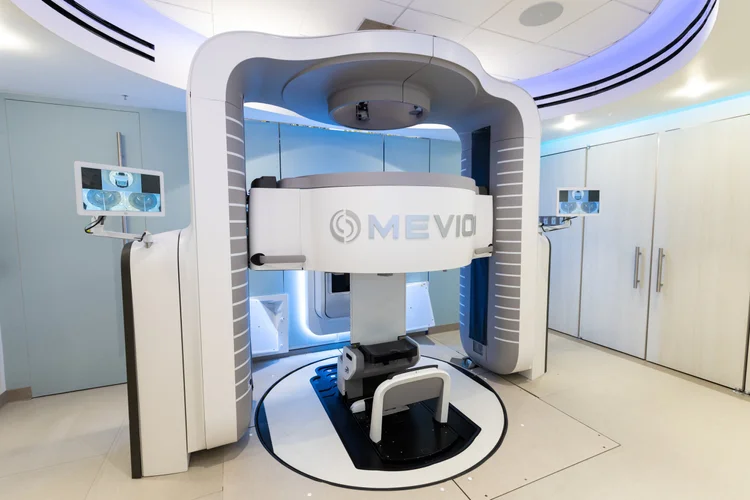
It has been an exciting month for Leo Cancer Care, subsidiary of Centaur Health, a portfolio company of Serra Capital III and Serra Capital III SBIC. Marie® by Leo Cancer Care made history at Stanford Medicine, with the world’s first in compact upright proton therapy. The first ever therapy treatment was performed on a child, making this milestone the moment upright proton therapy moves from innovation to adoption — and reflects exactly what Leo Cancer Care built Marie® to achieve.
"This milestone represents an important moment not only for Leo Cancer Care, but for the future direction of radiation oncology. For decades, proton therapy has delivered remarkable clinical benefits but has remained limited by the scale, complexity, and infrastructure demands of traditional systems. By enabling treatment in an upright position using a fixed-beam approach, we are helping redefine how proton therapy can be delivered — making it more compact, more flexible, and potentially accessible to far more patients around the world,” said Stephen Towe, CEO, Leo Cancer Care.
To view the entire article, follow here.
More About Leo Cancer Care
It's estimated that we spend two-thirds of our lives upright, standing, sitting, or moving in our natural position. At Leo Cancer Care, we are committed to challenging the conventions of radiation oncology by reintroducing upright treatment to radiotherapy practice.
Our Marie® suite of upright positioning and imaging solutions was created with two complementary goals: transforming the patient experience and expanding access to advanced radiotherapy. By shifting from machine rotation to patient rotation, Leo Cancer Care enables more compact treatment environments while allowing patients to remain in a more natural and comfortable position.
This approach supports improved patient interaction, potential motion reduction, and more flexible treatment delivery, while also helping healthcare providers overcome infrastructure and cost barriers associated with traditional systems.
Leo Cancer Care is proud to be working alongside leading healthcare institutions and industry partners to support the evolution of radiotherapy — enabling more accessible, sustainable, and patient-centered cancer treatment worldwide.